
Split Shank Engagement Rings in Solid 9ct, 14ct & 18ct Gold
In a split shank ring the band divides as it approaches the centre stone, so that two arms meet the setting instead of one. The effect is architectural: the stone appears to float in the gap the split creates, and the negative space around it makes the diamond read larger than the same stone on a solid band.
It is the setting that does the most for an elongated shape. All twelve designs use lab grown diamonds in solid 9ct, 14ct or 18ct gold — never plated — from £1,750, made to order in 10 to 14 days.
-
Oval Lab Grown Diamond Split Shank Engagement Ring 2.0ct | Qutahia Jewellery
Regular price From £2,400.00Regular price£2,700.00Sale price From £2,400.00Sale -
Marquise Lab Grown Diamond Split Shank Engagement Ring 2.0ct | Qutahia Jewellery
Regular price From £2,750.00Regular price£3,000.00Sale price From £2,750.00Sale -
Emerald Lab Grown Diamond Split Shank Engagement Ring 2.0ct | Qutahia Jewellery
Regular price From £2,400.00Regular price£2,700.00Sale price From £2,400.00Sale -
Cushion Lab Grown Diamond Split Shank Engagement Ring 2.0ct | Qutahia Jewellery
Regular price From £2,400.00Regular price£2,600.00Sale price From £2,400.00Sale -
Oval Lab Grown Diamond Split Shank Engagement Ring 1.5ct | Qutahia Jewellery
Regular price From £1,700.00Regular price£2,100.00Sale price From £1,700.00Sale -
Marquise Lab Grown Diamond Split Shank Engagement Ring 1.5ct | Qutahia Jewellery
Regular price From £1,800.00Regular price£2,250.00Sale price From £1,800.00Sale -
Emerald Lab Grown Diamond Split Shank Engagement Ring 1.5ct | Qutahia Jewellery
Regular price From £1,700.00Regular price£2,100.00Sale price From £1,700.00Sale -
Cushion Lab Grown Diamond Split Shank Engagement Ring 1.5ct | Qutahia Jewellery
Regular price From £1,650.00Regular price£2,100.00Sale price From £1,650.00Sale -
Oval Lab Grown Diamond Split Shank Engagement Ring 1.0ct | Qutahia Jewellery
Regular price From £1,400.00Regular price£1,750.00Sale price From £1,400.00Sale -
Marquise Lab Grown Diamond Split Shank Engagement Ring 1.0ct | Qutahia Jewellery
Regular price From £1,450.00Regular price£1,800.00Sale price From £1,450.00Sale -
Emerald Lab Grown Diamond Split Shank Engagement Ring 1.0ct | Qutahia Jewellery
Regular price From £1,400.00Regular price£1,750.00Sale price From £1,400.00Sale -
Cushion Lab Grown Diamond Split Shank Engagement Ring 1.0ct | Qutahia Jewellery
Regular price From £1,400.00Regular price£1,750.00Sale price From £1,400.00Sale

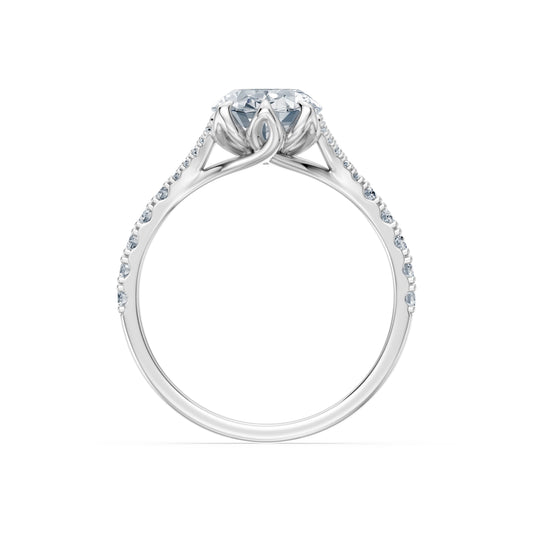

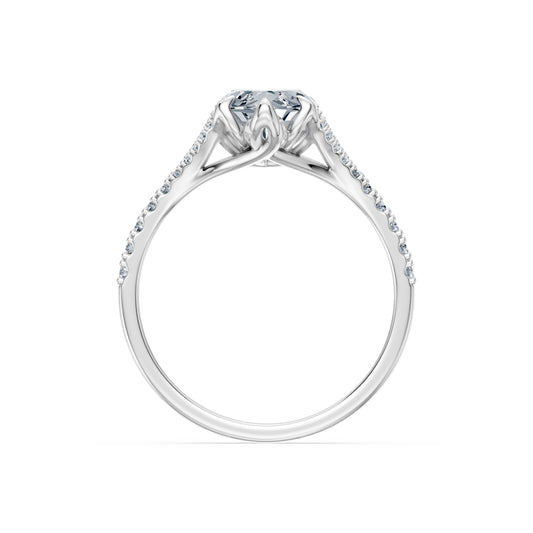

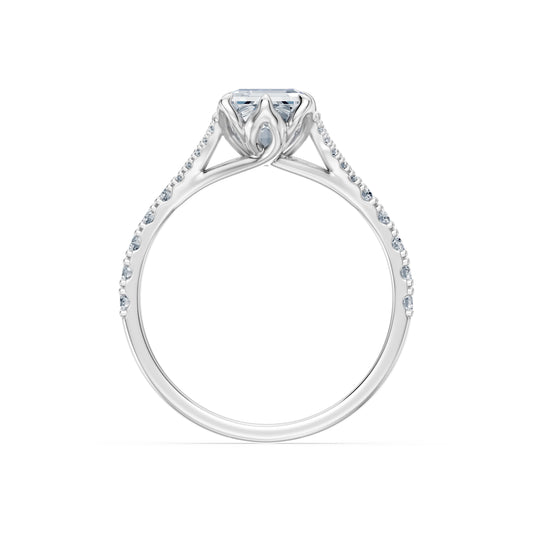

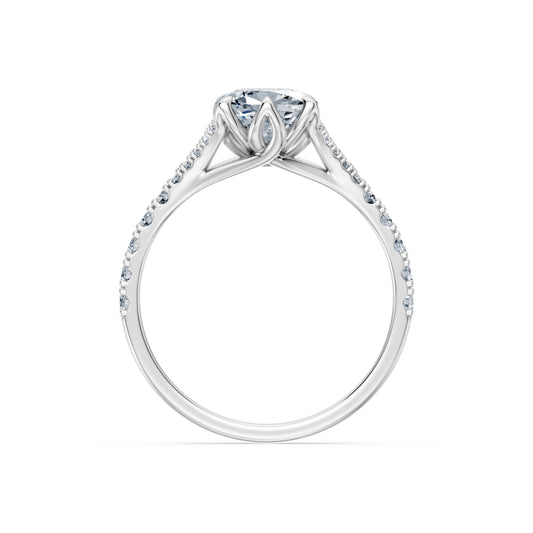

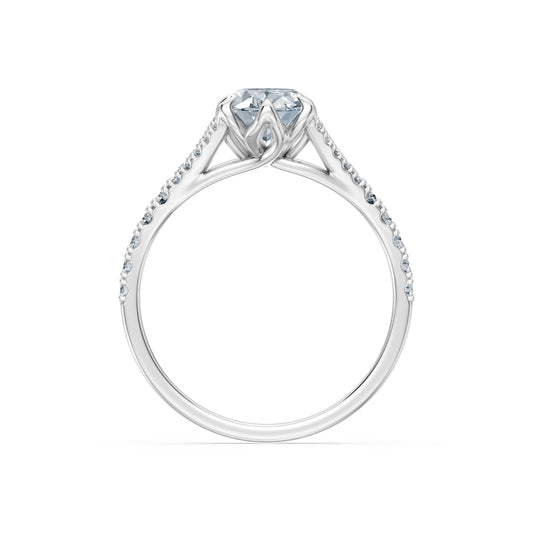

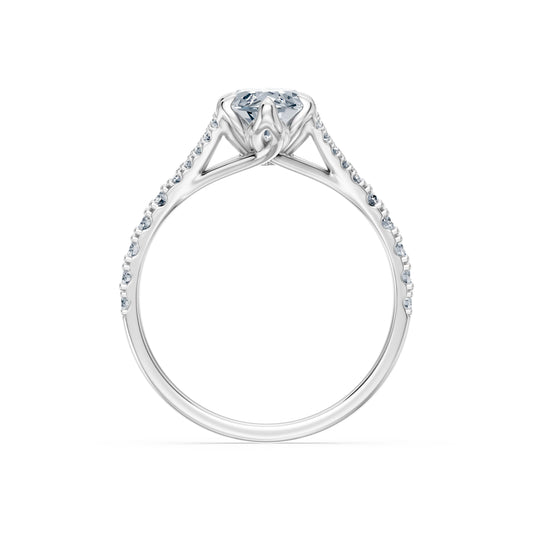

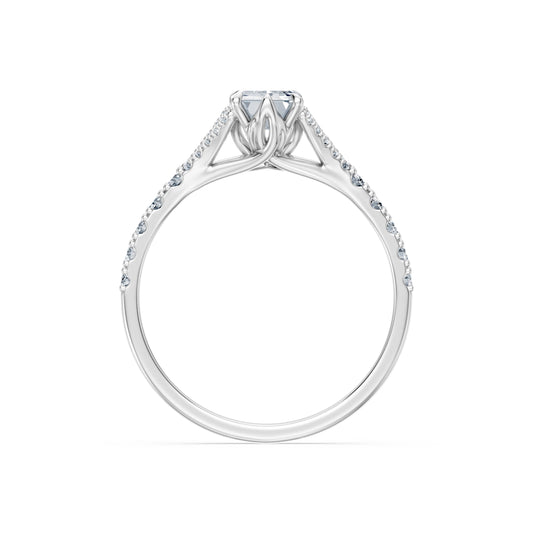

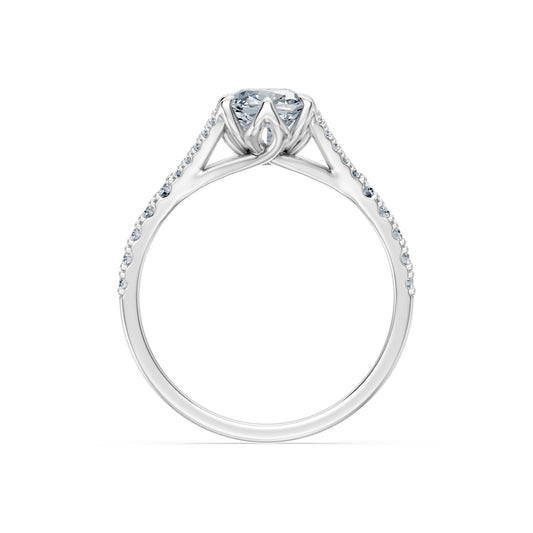

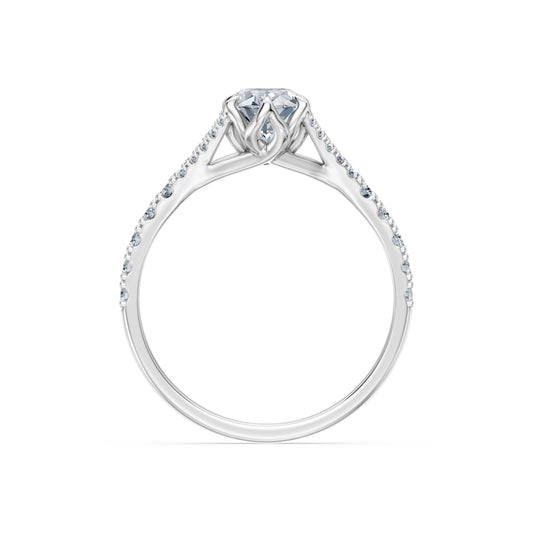

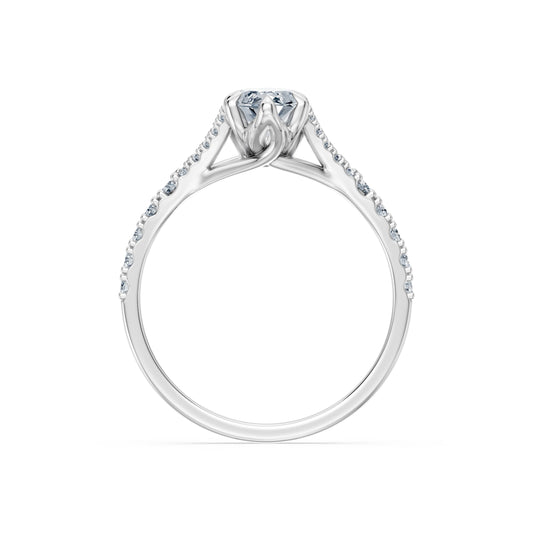

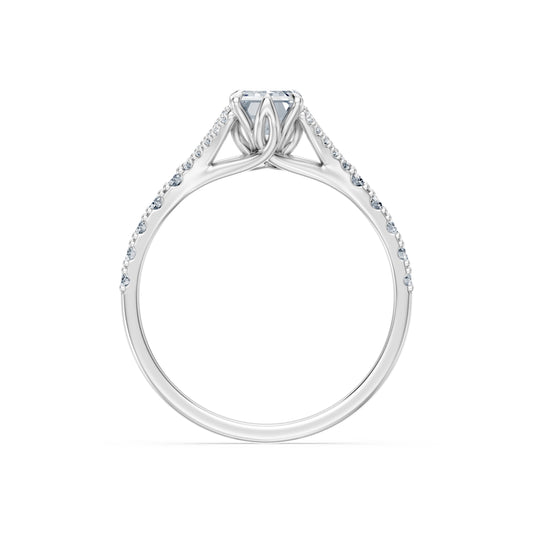

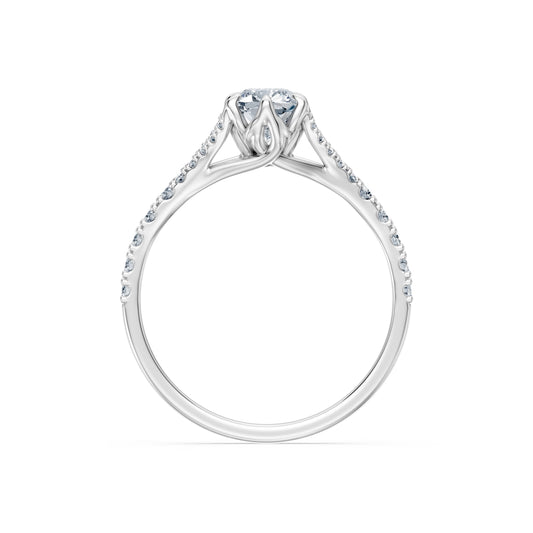
Negative space is doing the work
A split shank makes a diamond look bigger without adding a single stone to it, and the mechanism is worth understanding because it is purely optical.
On a solid band, the metal runs continuously into the setting, so the eye reads band and stone as one connected object. Split the band and you introduce two small openings on either side of the centre. The eye now reads the stone as separate, framed, sitting in space — and an isolated object always looks larger than a connected one.
It costs nothing in carat. Compared with a hidden halo or a cluster, which buy apparent size with extra diamonds, the split shank buys it with geometry alone.
Why it suits elongated stones best
A split shank has a direction: the arms sweep outward as they approach the setting. Put a long stone in that frame and the two lines reinforce each other, so an oval, a marquise or an emerald cut looks longer and more deliberate.
With a round or a square stone the split still works, but it is decoration rather than reinforcement — the frame points somewhere the stone does not go. If you are choosing between settings for an elongated diamond, this is the one that flatters it most.
A cushion sits interestingly in between: square enough to be neutral, soft enough that the sweep still reads.
The wedding band question
This is the split shank's genuine trade-off and it deserves stating plainly.
Where a normal band meets a solid shank in one place, it meets a split shank at two points that are wider apart and often at different heights. A straight wedding ring frequently will not sit flush. Options:
- Wear them apart. Increasingly common, and it avoids the problem entirely.
- A contoured band shaped to the split. Fits precisely, but only that ring.
- Choose a shallow split. Some designs split only in the last few millimetres, which leaves enough parallel band for a straight ring to sit against.
Decide before the ring is made. We can adjust how far down the band the split begins, and that single choice determines everything about how the two rings sit together later.
Practical notes
Resizing. A split shank can be resized, but the work happens at the bottom of the band where the two arms have rejoined. If the split runs most of the way round, or is set with pavé along both arms, the room to work shrinks. Give us your size at the point of order.
Strength. Two thinner arms are not weaker than one thicker band as long as they are properly proportioned — the load is shared. What matters is that the arms are not made unnecessarily fine for the sake of delicacy. Ours are cut to take daily wear.
Cleaning. The gaps collect less than a pavé band and more than a plain one. A fortnightly wash with warm water and a soft brush is enough.
What a split shank engagement ring costs
This collection runs from £1,750 to £3,750. The split adds a little to the making — two arms take more shaping than one band — but centre stone weight remains the main driver.
Every ring here uses lab grown diamonds, which is why two-carat centres appear at these prices. Gold carat moves the total least: 9ct is harder and more scratch-resistant, 18ct is richer in colour and softer, 14ct is the usual middle ground for an everyday ring.
Common questions
Does a split shank make the diamond look bigger?
Yes, and without adding stones. The openings on either side isolate the centre stone visually, and an isolated object reads larger than a connected one. The effect is strongest on elongated shapes.
Can you wear a wedding band with a split shank?
Yes, but a straight band often will not sit flush. Either choose a shallow split, have a contoured band made, or wear the two separately. Plan it before the engagement ring is made.
Is a split shank harder to clean?
Marginally. There is more surface and there are more edges, but far fewer trapped spaces than on a full pavé band. Warm water and a soft brush once a fortnight covers it.
Can I choose where the band splits?
Yes, and it is worth doing. Everything is made to order in our own workshop, so the split depth, centre stone, gold carat and finish are all specifiable. If what you want is not shown, commission it — the first conversation costs nothing.
Frequently asked questions
What is a split shank ring?
The band divides into two (or more) strands as it approaches the centre stone, which frames the diamond and can make it appear larger against the narrower double band.
Does a split shank make the centre stone look bigger?
Yes — the narrower divided band creates more visual contrast around the stone, which tends to make it read larger than the same stone on a plain single band.
What's the starting price for a split shank ring?
From around £1,750 in solid gold, made to order.
Is a split shank ring comfortable for daily wear?
Generally yes, though the divided band can feel slightly different against the finger than a solid band — most customers adjust within the first few days of wear.